We are excited to announce that Brink is now part of Africa Practice. Learn more
The burden of success: how Kenya’s high-growth founders are mentoring themselves to exhaustion
It’s 8:30 AM on a Monday in Nairobi, and Wanjiku’s inbox is a graveyard of well-intentioned irrelevance.
As the CEO of a Kenyan tech-logistics firm that recently crossed the 60-employee mark, Wanjiku is officially a “High-Growth Company” (HGC) founder. But her digital morning tells a different story. There is an invitation to a “pitching masterclass” for seed-stage startups. There is a newsletter from a donor-funded accelerator offering “mentorship” from someone who has never lived through a local currency devaluation or a talent raid. There is a LinkedIn notification about a new “Startup Bill” that, curiously, would stop recognising her company as a startup just as it finally gains real momentum.
The disconnect is palpable. While the ecosystem celebrates the “hustle” of the garage-stage entrepreneur, Wanjiku is fighting a different war. She is navigating the “Scale-Up Gap”, that precarious middle ground where a company is too big for startup grants but “too African” and “too risky” for the patient, large-scale commercial capital required to go regional.
At Africa Practice, we have spent years at the intersection of policy and the pavement. What we see is a systemic misalignment: Kenya has built a magnificent engine for starting businesses, but we have yet to build the highway for scaling them.
The 15% that carry the weight
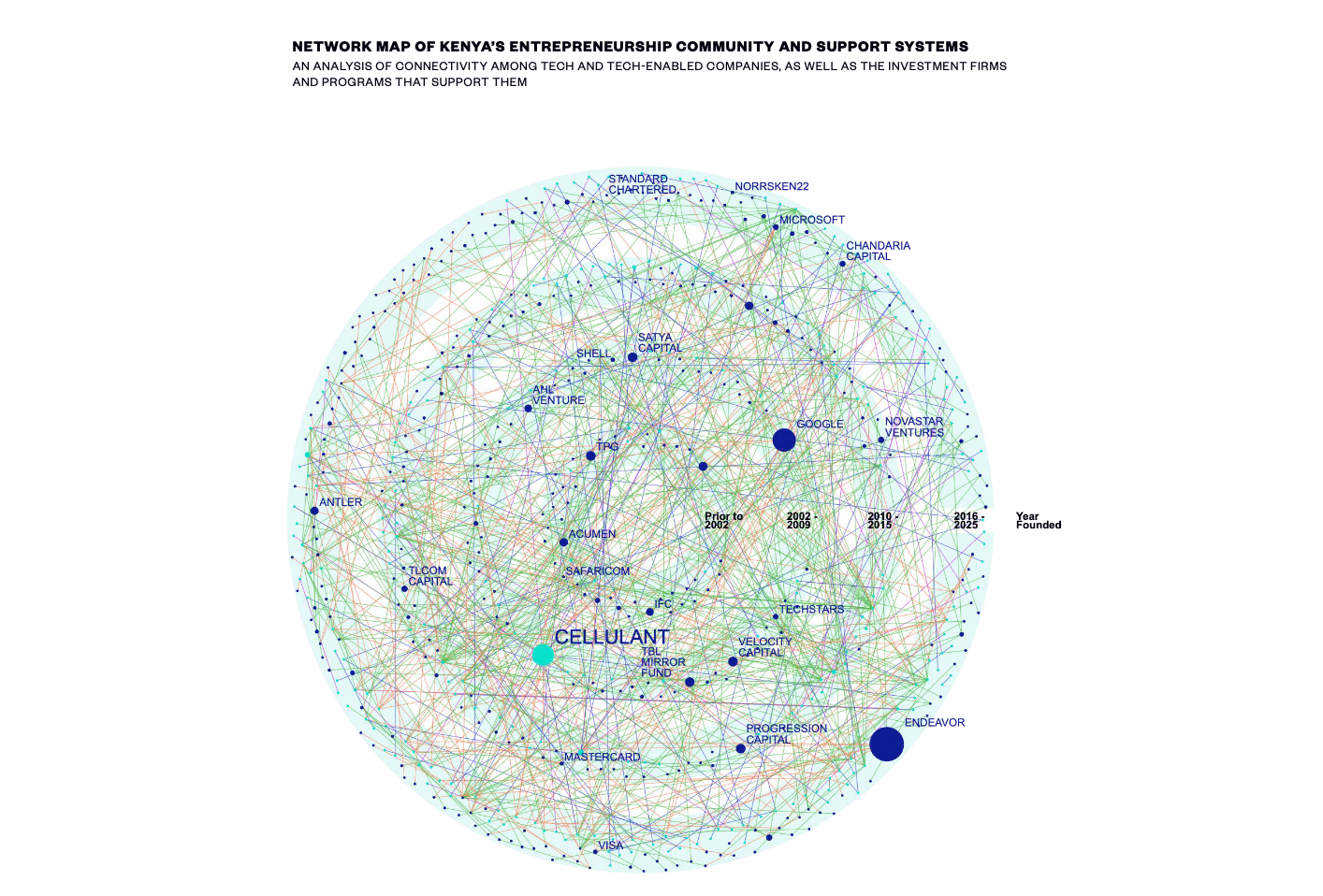
Our recent report, Mapping the Kenyan Entrepreneurship Network, developed with our partners Endeavor and KPMG, reveals a striking reality. High-growth companies—those with over 50 employees—account for only 15% of the tech-enabled entrepreneurial landscape. Yet, this small cohort generates the vast majority of high-quality jobs and pays significantly higher wages than their smaller counterparts.
These are the companies that will drive Kenya toward Vision 2030. They are the “training grounds” for the next generation; over 36% of HGCs have already spun off “second-generation” companies. But instead of being cleared for takeoff, these founders are running into a series of systemic headwinds.
Crucially, the timeline to reach this point is much longer than most assume. In Kenya, it takes an average of 10 years for a company to reach meaningful scale. When policy frameworks or support programs are designed around a shorter window, they risk withdrawing support just as a company enters its most critical, capital-intensive growth phase. We cannot build a high-growth economy on a three-year cycle.
The ecosystem burden: why “paying it forward” is stalling
One of the most sobering insights from our research is the state of Kenya’s “pay-it-forward” culture. In mature ecosystems like Silicon Valley or London, scaled founders are the primary source of angel investment and mentorship for the next crop. In Kenya, HGC founders want to give back—in fact, they are twice as likely to mentor others than early-stage founders—but they are hitting a wall.
We call it the Ecosystem Burden. Because there are so few HGCs, the few founders who have successfully scaled are spread impossibly thin. They are being asked to sit on every government task force, speak at every donor conference, and mentor dozens of startups, all while fighting a “war for talent” against global giants like Google and Microsoft, who can outbid them for technical staff.
When the burden of sustaining an entire ecosystem falls on the shoulders of a few dozen people, the network becomes brittle. We don’t just need more startups; we need to lighten the load for those at the top so they can become the institutional investors and mentors of tomorrow.
From impact to commercial viability
For too long, the Kenyan ecosystem has been influenced by a top-down, donor-driven model. While early-stage focused Entrepreneurial Support Organisations (ESOs) have been vital in the “zero-to-one” phase, Kenya now needs fit-for-scale up ESOs equipped for the “one-to-hundred” journey.
Many Development Finance Institutions (DFIs) and donors remain focused on early-stage, impact-oriented support or conservative downside protection. This creates a vacuum in the capital stack. We see a desperate need for fit-for-purpose financial vehicles—debt in local currency that doesn’t require “blood, sweat, and title deeds” as collateral, and equity that understands a decade-long path to scale isn’t a failure, but a foundation. To secure Kenya’s future, the focus must shift from subsidising survival to fueling commercial viability and long-term expansion.
A new architecture for growth
The solution is not a single policy shift or a new grant program; it is a systemic shift in how the network recognises and sustains its most successful members.
At Africa Practice, our role is to facilitate the “systemic sensitisation” required to bridge these gaps. We need an ecosystem that acknowledges HGCs as a distinct class with unique needs. This requires ESOs to move beyond the “one-size-fits-all” curriculum and instead support the sensitisation of the funding community. If funders can be equipped to understand the reality of the 10-year scaling horizon, the weight of the ecosystem burden, they can begin to structure the patient, flexible financial products that HGC founders actually need.
Simultaneously, policymakers must be equipped with the data and the nuanced ecosystem understanding to be more targeted. And ESOs and other partners have an important role to play here to avoid it all landing on the shoulders of the few once again.
Wanjiku doesn’t need more “mentorship” from people who haven’t walked her path. She needs a system that respects her timeline, a capital market that understands her risks and role in the ecosystem, ESOs that lessen the load through active engagement in sensitisation and policy design, and a policy environment that provides the pavement for her to hit the accelerator.
If this sounds familiar, if you are an ecosystem player, ready to move in unison with the system, get in contact with us. Our Entrepreneurship team is only getting started. [email protected]


Proud to be BCorp. We are part of the global movement for an inclusive, equitable, and regenerative economic system. Learn more