We are excited to announce that Brink is now part of Africa Practice. Learn more
Beyond the horizon: mapping Africa’s future in an era of flux
We are witnessing a real-time remaking of global politics and the world economy, a shift so profound and so contradictory that the old world is fading while the new one struggles to be born. At Africa Practice, we believe that navigating this requires more than just standard forecasting. It demands a specific kind of Futures Thinking—one that combines rigorous methodological frameworks with deep, human intelligence.
Our methodology: containers and catalysts
To understand where the world is going, we must distinguish between the stage and the players. We view the future through two distinct lenses: containers and catalysts.
The Containers are the constraints. These are the fundamental, often unmovable realities of our physical and biological world that define the arena in which we operate.
- Ecology: We live on a planet with finite resources and following determined climate rules.
- Demographics: We are biological creatures who age, reproduce, and migrate.
- Biotechnology: The very limits of our health and lifespan are being rewritten.
The Catalysts are the accelerants. These are the tools—primarily Artificial Intelligence and quantum computing—that change the speed and method by which we interact with those constraints. While the containers set the rules of the game, the catalysts determine how fast the game is played.
What we see: the view from Africa
When we apply this framework to Africa, three dominant trends emerge that go beyond simple data points.
First, demographics are shifting power. By 2050, Africa will be home to 1 billion young people, or 40% of the continent’s population. This is not another “stakeholder group” or statistic; it is a parallel electorate, if not THE electorate, impatient for change. This “Digital Electorate” operates outside traditional institutions, mobilising on digital platforms to challenge authority and demand economic opportunity. For our clients, this means the licence to operate has shifted from Business-to-Government (B2G) to Business-to-Population (B2P). Legitimacy must now be earned in the digital court of public opinion.
Second, ecology is driving resource nationalism 2.0. The global energy transition requires critical minerals—lithium, cobalt, copper—and African governments recognise their unprecedented leverage. The era of simply exporting raw ore is over. We are seeing a sophisticated drive for “supply chain sovereignty,” where nations negotiate as strategic partners to build local industrial bases.
Third, sovereignty is non-negotiable. The shocks of the pandemic and climate change have triggered an intense drive for self-reliance in food and pharmaceuticals. The new political demand is for localised production. The message to multinationals is no longer “sell us your products,” but “help us build our sovereign capacity”.
The human element
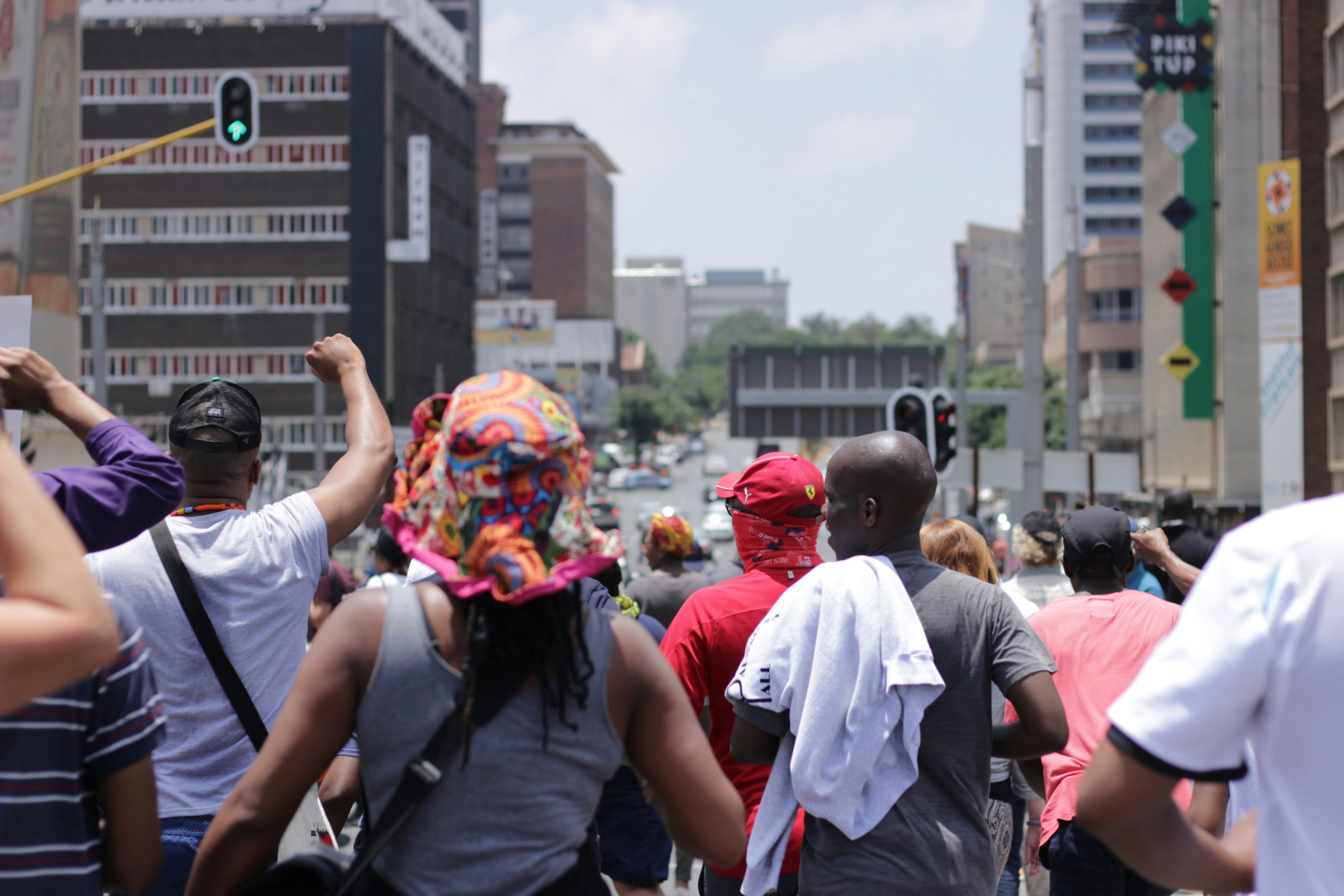
While AI helps us model these fluid realities and predictive pathways, it cannot replace the nuance of human understanding. “Truth” in this new world is often subjective, shaped by narratives and identity. It takes deep human intelligence to interpret the demands of a youth protest in Nairobi or the geopolitical signalling of a mining law in Windhoek.
The future isn’t just something that happens; it is something we can shape. By understanding the constraints of the containers and leveraging the power of the catalysts, we help our partners move beyond uncertainty to find their fit in the future world.
Proud to be BCorp. We are part of the global movement for an inclusive, equitable, and regenerative economic system. Learn more