We are excited to announce that Brink is now part of Africa Practice. Learn more
AI Doesn’t Need Perfect Classrooms

The common picture of artificial intelligence assumes the cloud, enormous compute power, fast connectivity and English. A subtler approach is already working in the world’s most constrained classrooms, on cheap phones and weak signals, in local languages. It points to an equally capable way of building with AI, and to where the money now flowing toward it could land.
Ask most people what artificial intelligence needs in order to work, and the answer comes back in a familiar shape: a model, computing power, a data centre, a fast connection and a great deal of English. That picture has mostly hardened into common sense, but for a growing number of classrooms, it may be out of date.
In Ghana, a teenager opens WhatsApp on a ten-dollar phone and begins a maths lesson with a tutor that has no face, no fee and no need for fast internet. There is no laptop in the room, no broadband, no specialist on hand. The tutor is an AI tool, and in a randomised trial across eleven schools, one such tool, Rori, produced learning gains worth roughly an extra year of schooling, at a marginal cost of about USD 5 a child. It now reaches more than forty thousand learners.
This is AI built on a premise that it should meet people where they are, rather than demand they arrive where the technology is most comfortable. It runs on the edge or keeps working offline, on little or no connection. It is built for the languages and cheap devices people actually have. The most underserved classrooms are where it is being proven, and too few non-specialists realise it is possible at all.
For years the argument for technology in Africa ran on a sequence: first the infrastructure, then connectivity, then devices, and only then the clever software. The places that needed it most always sat at the wrong end of that queue, which is one reason many well-funded edtech pilots have struggled to move beyond the pilot stage. The mistake was assuming infrastructure must be solved before intelligent tools can add value. Small, low-footprint AI can reach a learner now, in a crowded classroom or, where there is no school within reach, on a cheap phone at home. It’s an uneven route, sure; because across Africa, 63% of people still do not use mobile internet despite being covered by mobile broadband, and the households furthest from accessible education centers tend to be the least likely to own a phone or a smartphone. But it is also one more reason to build for the cheapest devices and for the text and voice channels a basic phone can reach.
What already works
The evidence is not as thin as it once was. Just under a year ago, we studied how AI is transforming or could transform education across six African countries, and the same finding kept surfacing: it already works, at both ends of the connectivity spectrum. On low bandwidth, Rori, the WhatsApp maths tutor, has shown gains of around a third of a standard deviation in school studies, on basic phones.
FoondaMate, a study tool leveraging WhatsApp and Messenger, now helps more than a million students on cheap handsets and little data. At the connected end, a World Bank trial in Benin City, Nigeria, paired a generative tutor with teachers in the room and reported gains of about a third of a standard deviation in six weeks, with especially strong results for girls.
The offline and edge end is where some of the most interesting work is now happening. In Ethiopia, GlobeDock Academy runs an AI-powered, offline-first platform that reaches more than 200,000 secondary learners across 200 towns, syncing through SD cards and local caching where the network will not. In Kenya, Juza AI packages a curriculum-aligned tutor into an offline ‘AI in a box’ that runs on a low-power computer in classrooms in Samburu, Isiolo and Garissa, though it is still early. Elsewhere the same approach is already operating at volume: in India, an on-device oral-reading tool has run more than three million checks, and offline tablet programmes have produced multi-year learning gains in Malawi. A 2025 background paper for UNESCO’s Global Education Monitoring Report goes so far as to make ‘start offline’ its first principle for scaling AI in African schools.
So the question is less about whether these tools can work and more about why so few of them move beyond successful pilots. The recurring failure in African edtech has been the leap from a working pilot to a national system: a programme excites expectations in a district, then thins out when the coaching, the budgets and the systems do not follow. The same UNESCO paper indicates that pilots succeed while diffusion stalls. That is the real problem to solve, and it is perhaps a problem of architecture; the shared scaffolding that lets a good tool outlast its grant.
Built for constraints
Edge AI runs models on local devices, whether a phone, tablet, or school server, so learning does not depend on a constant connection to a distant data centre. Smaller, more efficient models can operate on limited hardware and unreliable power, making them practical in environments where resources are constrained. Offline-first software takes the same approach; it works without connectivity and can synchronise when and if a connection is restored. These are established engineering choices that prioritise resilience and reliability, ensuring technology remains useful under real-world conditions in resource-constrained markets.
None of this is a wager against connectivity (the objection that usually comes next), because the three hold their value regardless; edge inference can be faster, cheaper and more private, even in cases where connectivity is reliable. Small models are cheaper to run and easier to govern at any bandwidth. Offline-first is sound engineering for a tool that must survive with significant constraints. Built this way, the tool works whether the link is strong, weak or gone.
The math supports the case. As recently as 2021, 82% of students had no home internet, 89% had no computer. Class sizes often exceed 40 pupils against an OECD average around half that. A system built only for the connected, well-equipped child propagates the education challenge.
Also, capability is not the same as fit. Even a strong connection only sharpens the question: online to what? A tutor trained on a foreign syllabus, priced in dollars and fluent only in English will misfire in a multilingual classroom on a national curriculum. This was one of the silent killers of the last edtech wave: tools that mirror someone else’s schooling get rejected by the teachers and ministries who live with them. Meeting the learner in their own languages and on their own devices is the point.
The missing scaffolding
Which brings me to the part no single startup can solve, and the real work ahead. A scaffolding layer is missing. The talent is mostly there, the tools are mostly there, nearly 3,000 edtech ventures are there. What is maybe missing are the shared public goods that let any of them scale beyond a pilot: curriculum-aligned content repositories a developer can build on without starting from scratch; local-language corpora with clean licensing; lightweight model baselines tuned to local contexts; the horizontal AI infrastructure and shared developer rails that every application can draw on. This is the case for an education digital public infrastructure (DPI): a public, governed layer of educational goods that sits inside the national system, and that schools, teacher colleges and developers can all draw from. I think of it as a stack.
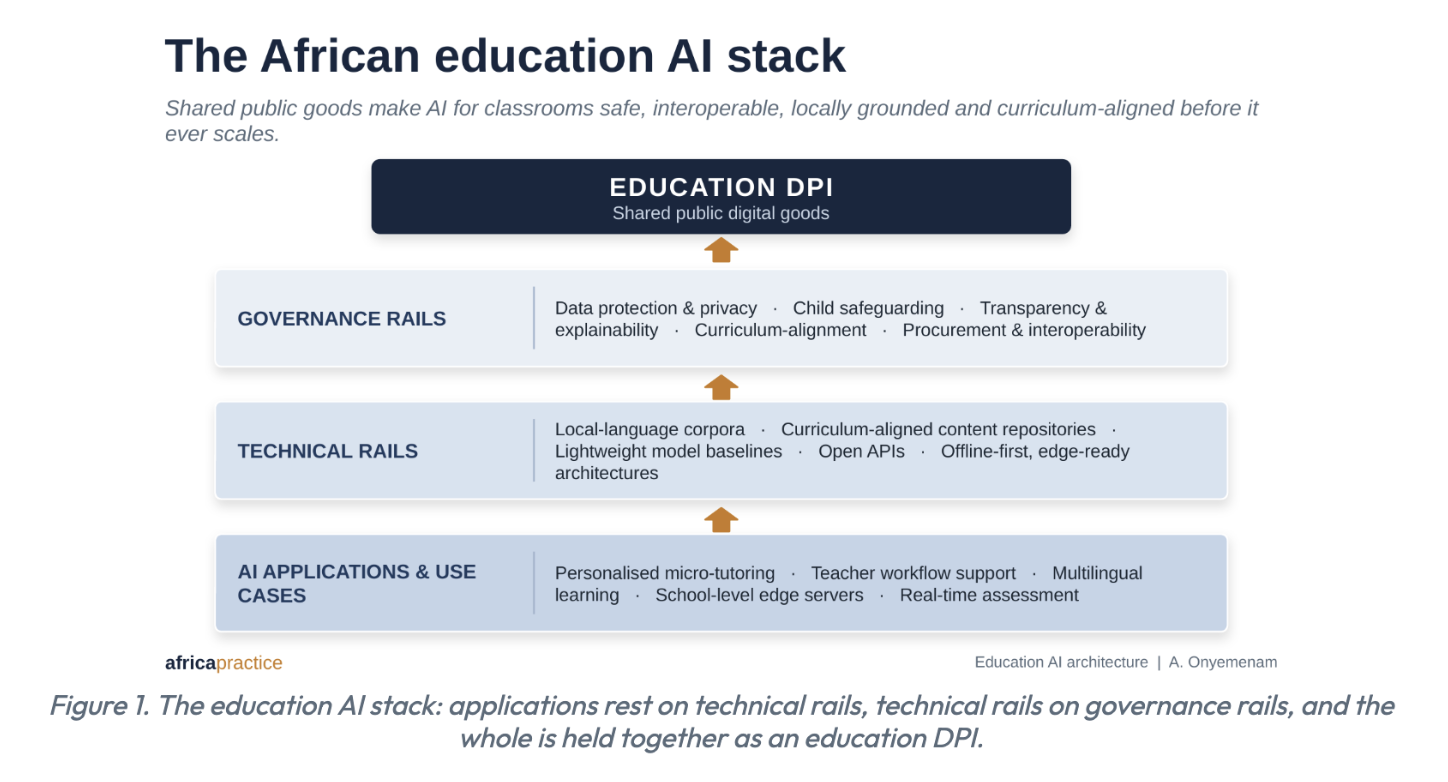
At the base sit the applications a child or teacher actually touches: micro-tutoring, workflow support, multilingual learning, school-level edge servers. Above them run the technical rails, the corpora and model baselines, edge, full connectivity, low-footprint, and offline-ready architectures and APIs. Above those sit the governance rails: privacy standards, safeguarding protocols, curriculum-alignment and procurement rules. The whole is held together as an education DPI, a set of shared public digital goods that make technology for learning safe, interoperable, locally grounded and curriculum-aligned before it ever reaches a child at scale. Get the stack right and a thousand local builders can stand on it. Get it wrong, or leave it to chance, and we will keep funding pilots that die at the edge of their grant.
Where the money should land
The African Union has set a decade-long education agenda, and the African Development Bank, with the UN Development Programme, has launched an initiative to mobilise up to USD 10 billion for AI by 2035, organised around five enablers: data, compute, skills, trust and capital. An education stack is where four of those five meet a learner. The question that follows is where the spending, if it comes, should land: on the shared rails, corpora, safeguards and teacher tools that compound, rather than on another round of pilots that each rebuild the same foundations alone. In April, the region’s ministers reframed DPI as the rail and intelligence as the train. For once, the language of public goods is ahead of the procurement, and the window to build this layer deliberately, rather than inherit it by accident from whichever vendor moves fastest, is open now.
The two things I would not compromise
The first is pedagogy. A tool that is technically elegant and pedagogically empty will teach a child to game it. The content has to rest on evidence about how children actually learn and how cognition actually works; sequenced for real curricula, vetted by the people who train teachers. Otherwise we will automate poor instruction at scale, which is worse than the gap we started with.
The second is the teacher, where a teacher exists. Every serious finding in our research, and every honest founder we interviewed, pointed the same way. If a tool adds to a teacher’s workload, it dies. If it fails to earn a teacher’s trust, it never scales. One founder told us: student-facing tools fail when they create more work for teachers, so design for the teacher as carefully as the learner. In most education systems, teachers remain the highest-leverage point in the chain, the actor who can turn a clever app into learning or just let it gather dust. Yet the lesson is not necessarily that every solution must begin with the teacher. In places where teaching capacity is absent or severely stretched, AI tools that can operate within resource constraints may need to support learners directly. The common principle is that technology should strengthen the human support around learning, whether that support comes from a teacher, a parent, a community center or, in some cases, a learner working independently.
Built for the world as it is
What stands between a working pilot and a working system is the unglamorous, deeply political work of building the public goods that let good tools scale, getting the pedagogy right, and keeping teachers at the centre of the design rather than at the mercy of it.
If the money now being raised builds the rails, the corpora, the safeguards and the teacher tools, it will compound for a generation. If it scatters across pilots that each start from scratch, we will have spent a fortune to relearn an old lesson. Beneath the spending sits the larger point. A learner in an under-resourced environment does not need us to wait for perfect conditions, nor to import tools built for a different world. She needs small, capable, locally grounded AI, the shared infrastructure that makes it dependable, and, where available, a teacher whose hand it strengthens. AI built for the African learner as they are, rather than the world we keep promising, already works. The only question is whether we will take it seriously.
This essay draws on a six-country study of AI in education conducted by Amaka and the team at Africa Practice, with the support of Google, African Leadership University and Sand Technologies.


Proud to be BCorp. We are part of the global movement for an inclusive, equitable, and regenerative economic system. Learn more