We are excited to announce that Brink is now part of Africa Practice. Learn more
What happens when a generation learns to think with AI before it learns to think without it?

On education, AI dependency and the risk that our demographic dividend will become a cognitive liability.
Africa has over half a billion young people aged 15 to 35, more than 22% of the global youth cohort. The entire development thesis for the continent rests on an assumption that, amongst other things, this generation will enter the workforce with the capacity for independent judgment, creative problem-solving and critical analysis. Education systems are supposed to build those capacities, however, AI is now undermining them speedier than curriculum reform can respond.
A RAND Corporation survey of over 1,200 American students, published in March 2026, found that 67% believe AI use is harming their critical thinking skills, up from 54% just ten months earlier. Over the same period, the share of students using AI for homework rose from 48% to 62%. Students know it is eroding their thinking, but they use it more anyway. Researchers describe this as “digital cognitive atrophy”, where frequent AI users show reduced neural activation in areas associated with working memory and analytical reasoning. A separate study across Indonesian universities found empirical evidence of declining critical thinking scores among heavy AI users.
The paradox comes into focus when you look at how students explain their own behaviour. Analysis from IMD frames it as rational resource allocation, that is, when the tasks education asks students to practise are precisely the ones AI handles most efficiently (formulaic writing, structured problem-solving, routine analysis), students outsource those tasks. The question is whether they redirect their effort towards higher-order thinking, or whether the cognitive muscles just atrophy from disuse.
The emerging evidence increasingly points (disturbingly) towards atrophy, and it creates a vicious cycle. As students delegate more cognitive work to AI, their confidence in their own reasoning declines, which increases their dependence on AI, which further erodes the very capacities the labour market increasingly demands. Researchers describe this as a “willing vicious cycle of technological dependence.”
If you apply this to the African context; education systems across the continent are already under-resourced. The Caribou Digital and Mastercard Foundation report on AI innovation clusters in Africa repeatedly identifies the skills gap as the binding constraint: young professionals have certificates but struggle to apply knowledge practically. Grassroots communities like Zindi, Data Science Nigeria and Deep Learning Indaba are filling parts of the gap, but they operate on volunteerism and limited funding. Formal universities face a shortage of professors qualified to teach AI-adjacent subjects, let alone to redesign pedagogy for an era in which one might consider AI is both a tool and a threat. Harvard Business Review researchers add a further dynamic, finding that in practice, AI does not free workers from drudgery; it intensifies work, raising output expectations, compressing timelines and creating new forms of cognitive load. So, if this pattern holds, the future labour market will demand more resilience, judgment and critical thinking from workers, precisely the capacities that early-stage AI dependency may be eroding in the generation preparing to enter it.
It also connects to a deeper structural tension, because, if the high-value human economy that Africa should be positioning itself to build, depends on care, community and creativity, then the capabilities that economy requires (empathy, judgment, cultural creativity, critical reasoning) are the very ones that AI-dependent education systems may fail to develop. The economic thesis and the education crisis are two sides of the same coin, because an economy organised around what humans do that machines cannot, is only as strong as the education system that produces the humans capable of doing it.
This is the cognitive cliff, as it were. On the one hand; a generation with unprecedented access to information and AI-powered tools that could, in theory, accelerate learning. On the other, a generation that has never been forced to develop the independent reasoning skills that the labour market, the civic sphere and democratic participation all require. WEF’s Future of Jobs Report is explicit about which skills will retain value through 2030: analytical thinking, creative thinking, resilience, flexibility, curiosity, and lifelong learning. For Africa, the stakes are existential in a way they are not for wealthier economies, because these economies have safety nets, retraining infrastructure and accumulated institutional capital to absorb a generational skills shock, but Africa mostly does not. As such, a demographic dividend built on a population that cannot think independently is a demographic crisis waiting to happen.
You may wonder what a serious response would look like. I don’t have all the answers, and honestly, I panic a little when I consider my younger cousins who are at this moment, going through high school and university. But if I were to speculate, first, African education systems need to redesign assessment, urgently, away from outputs AI can produce (essays, summaries) and towards demonstrations of reasoning process. Second, AI literacy should be taught as a critical capacity: understanding what AI does well, what it does badly, and when to distrust its outputs. Third, and probably most difficult, educators and policymakers need to defend the value of cognitive struggle. The discomfort of working through a problem without assistance is partly the mechanism through which human intelligence develops.
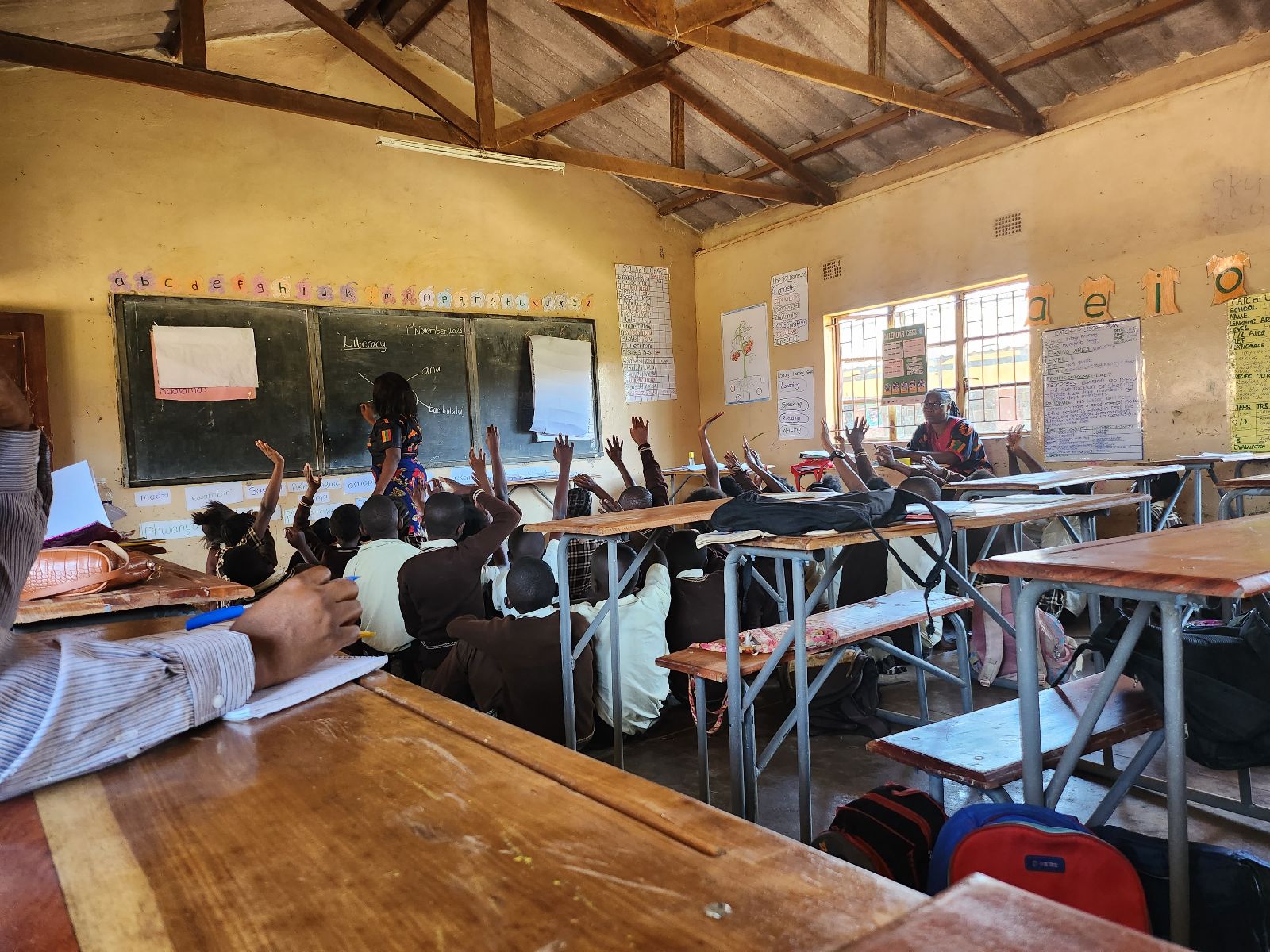
Like my younger cousins, the generation that will define Africa’s mid-century is in school right now, and whether they emerge with the capacity for independent thought or with a sophisticated dependency on machines that think for them is being determined today, largely by default, in classrooms that have no policy guidance on how to navigate this. AI isn’t by itself the real risk; the absence of a more concerted, deliberate response to it, is.


Proud to be BCorp. We are part of the global movement for an inclusive, equitable, and regenerative economic system. Learn more