We are excited to announce that Brink is now part of Africa Practice. Learn more
When the rules break: Data centres – between sovereignty and sustainability
Africa’s path to harnessing artificial intelligence (AI) and other emerging technologies is fundamentally constrained by a single physical truth: the exponential demand for power and water.
While most, if not all, African markets are driving the growth of their digital economies, their foundational goal – to keep data local for matters of ownership, governance, and cost – is now colliding head-on with the continent’s resource realities.
Data centres serve as the digital economy’s physical backbone, housing networked computers that work together to process, store, and share data. It is also where businesses and third-party providers house their IT infrastructure, and all the physical and virtual systems, networks, applications, space, power, cooling, racks, cabinets, and cabling that make a data centre operational. Africa’s nascent data centre market currently comprises an estimated ~230 facilities spread across 38 countries. Despite this presence, capacity is heavily clustered in a few major hubs, namely South Africa, Egypt, Kenya, and Nigeria. Moreover, it is estimated that the local demand of ca. 1,000 MW is currently met by only 360 MW of active capacity.
This concentration and overall limited capacity mean that most of the data generated on the continent is still hosted offshore, primarily in Europe and North America, a trend highlighted by the International Finance Corporation (IFC) and Global System for Mobile communications (GSMA). That said, Africa’s data market is poised for substantial growth, with projections indicating it will reach USD 9.2 billion with a compound annual growth rate (CAGR) of 7.18% by 2029. Demand for capacity is expected to rise from about 0.4 gigawatts (GW) to 1.5 to 2.2 GW, with an estimated revenue pool of USD 20 billion to USD 30 billion across the value chain by 2030.
Reliance on external hosting infrastructure introduces intricate, interwoven geostrategic problems, undermining African nations’ governance, sovereignty, and economic autonomy. Concurrently, the intense operational demands of modern data centres generate a critical trio of environmental pressures: rising energy consumption, increasing water usage, and associated carbon emissions.
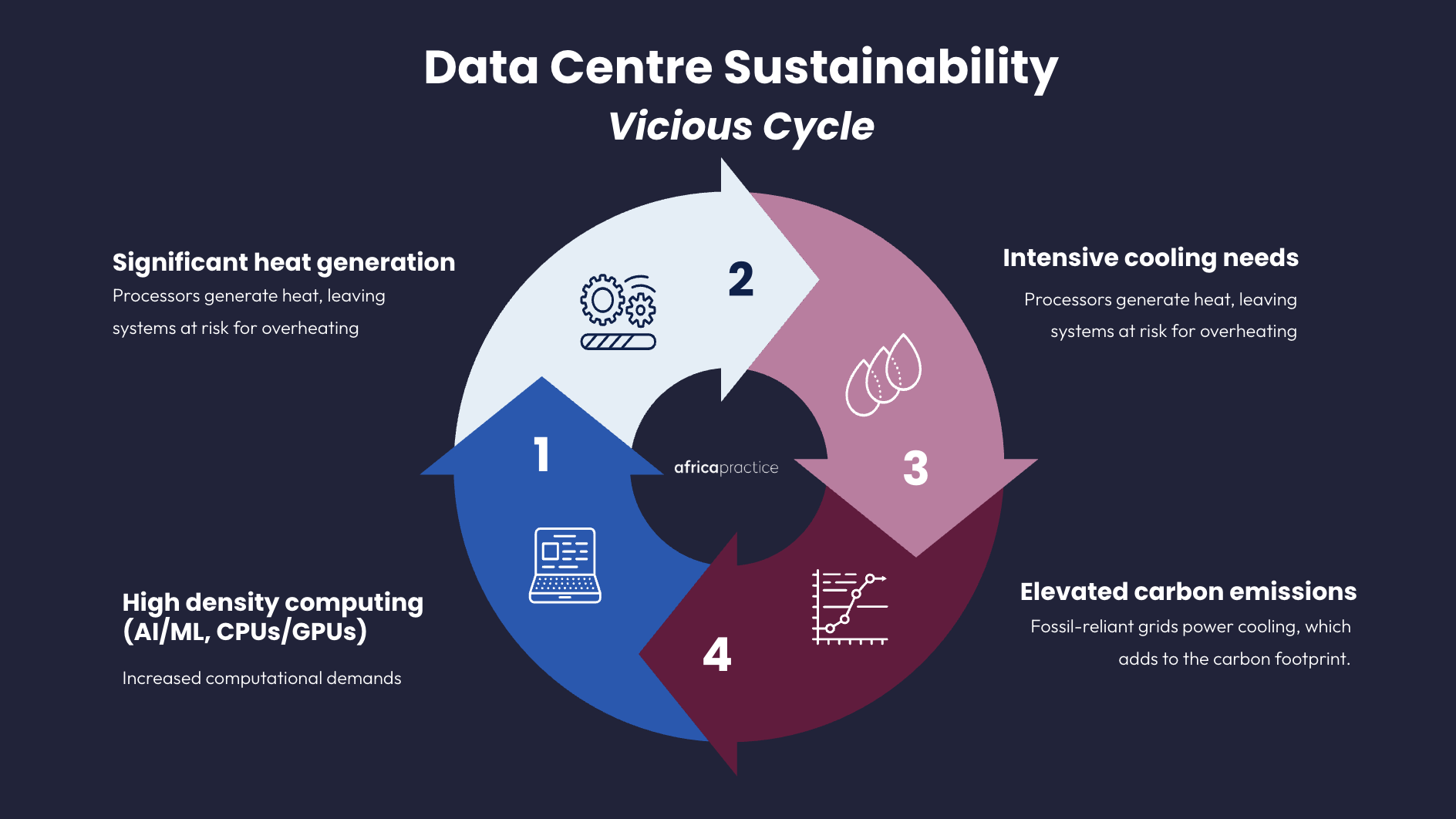
At the core of this issue is the need for cooling. As data centres expand their typical data processing operations – a demand further exacerbated by the rise of complex AI and Machine Learning (ML) workloads – the powerful processor chips (CPUs and GPUs) within the servers generate significant amounts of heat. To prevent overheating, which can lead to system malfunction, reduced performance, or even permanent physical damage to the hardware, effective cooling is paramount. This necessity for thermal management directly translates to larger amounts of water consumption. Water is often used in evaporative cooling systems, chilling systems, or as a component in closed-loop liquid cooling solutions to dissipate the heat.
Furthermore, this cooling requirement contributes substantially to the overall energy usage of a data centre. Not only is energy needed to power the servers themselves, but also to run the pumps, fans, and chillers that circulate the water or coolant and maintain the optimal operating temperature. Consequently, as energy use increases in data centres to power both computing and cooling infrastructure, so too do carbon emissions. Not least, since the vast majority of Egypt, Nigeria and South Africa’s electricity grid still relies on fossil fuels. Therefore, every kilowatt-hour consumed by a data centre adds to the facility’s indirect carbon footprint.
A consequence of meeting data centres’ significant energy and water needs is the exacerbation of energy insecurity, posing a significant threat to Africa’s climate resilience, equitable resource distribution for local communities, and sustainable development. Data centres can place undue pressure on local resources, threatening the clean water supply and electricity supply for domestic and agricultural use. The rapid and unplanned expansion of data centres hence fundamentally undermines fair service delivery, clean water provision, and reliable electricity access for the very communities in which they are situated.
This escalating deployment of large-scale data centres across prominent African economic hubs underscores a profound requirement for African nations to coordinate and advance comprehensive developmental strategies. This requires action across several critical areas: spatial development planning to seamlessly integrate these resource-intensive facilities into urban and regional landscapes; robust resource management, especially concerning energy and water; and integrated, broader economic development initiatives. These initiatives must harness the data revolution to drive innovation, create jobs, and improve digital literacy, extending the benefits beyond the physical infrastructure hosting itself.
This is especially important in safeguarding Africa’s digital and data sovereignty. From a security and economic perspective, controlling domestic data storage and the underlying digital infrastructure is becoming as critical as controlling energy supplies or key mineral resources. The ability of African nations to manage and control their own digital fate depends on this sovereignty. Without it, sensitive government, corporate, and citizen data remains susceptible to foreign access, surveillance, and exploitation, raising profound national security concerns. Economically, relying on foreign data centres and cloud services alone translates to a continuous outflow of capital, hindering the development of domestic digital economies and job creation in the high-tech sector. In the event of international disputes or geopolitical shifts, dependence on external data infrastructure leaves African states vulnerable to service disruption or unilateral data access restrictions.
Furthermore, African economies have a unique opportunity to learn from the energy consumption, sustainability, and grid management challenges faced by mature data centre markets in Europe and North America. By entering the market later, these economies can focus on building highly efficient and sustainable infrastructure from the outset. A country like Kenya, which already sources most of its grid power from renewable energy, is well-positioned to power their digital infrastructure sustainably. Not only does this serve as an opportunity to lower carbon footprints, but it can also lead to a significant shift toward more sustainable, future-proof data centre practices.
The establishment of robust, secure, and resilient data centre infrastructure transcends mere technological advancement; it is a fundamentally important prerequisite for Africa’s socio-economic progression and its successful integration into the global digital economy. This infrastructure is not just a collection of servers; it is the essential digital bedrock upon which modern, transparent, and equitable digital services are built across the continent’s most vital sectors. This is the continent’s bright and shining moment to build robust and scalable digital infrastructure that is human-centric and sustainable. If it is done right.


Proud to be BCorp. We are part of the global movement for an inclusive, equitable, and regenerative economic system. Learn more